Monday, October 7, 2013

Congressmen Drink and Asia is on the line as half of US Companies Plan to Dump US Treasuries


10/7/2013 Portland, Oregon – Pop in your mints…

We recently saw reports that a number of Congressmen reeked of alcohol as they exited the chambers the night the Government shut down. Apparently the only thing worse than the pressure of public office is these days is having to face it sober.

We have been here before, you can read our commentary from the days when the minority in Congress realized they could hamstring the majority because the country lacked fiscal disciplineback in 2011, and all of this innocent bickering began:

US Debt Ceiling Vote to Ignite Armageddon in Bond Markets?

This time, as both sides appear to be playing a dangerous game of chicken, the dire warnings of what will happen should the government default appear to be reaching a deafening crescendo. The Chinese and Japanese governments, both large holders of US Treasury paper, are both pressuring Washington for some sort of assurance on their “Investments.”

US Financial Executives are also beginning to worry.  In a recent survey on the perceived effects of a hypothetical debt ceiling breach, the Association for Financial Professionals summarized the survey responses as follows:

“A default would make U.S. Treasury securities, an investment vehicle used in many companies’ short-term investment portfolios, far less attractive. The survey found that one-sixth of U.S. organizations currently holding U.S. Treasury securities would shift out most or all of those investments if the debt ceiling isn’t raised in time. Another 36 percent of organizations would hold onto their current holdings of Treasuries, but would not purchase these securities going forward. 

Meanwhile, half of the respondents say that a government default would harm their organization’s access to, and raise their cost of, capital. An increase in the cost of bank credit and higher cost of debt financing were each cited as possible outcomes by 27 percent of financial professionals.”
In other words, a default would cause a nearly instantaneous shift in short-term investment preferences away from US Treasuries.  While this in and of itself would not be a concern under current monetary policy, even the Federal Reserve would be hard pressed to come up with a program for purchasing Government securities that have not yet come into existence.

Further, Joe Weisenthal over at the Business Insider presents a Goldman Sachs chart which refutes the argument floated by some that the US Treasury could continue to pay interest on its debts once it hits the debt ceiling.
Treasury Payments
It appears that once Halloween passes and the Federal Employees and Social Security recipients come calling on November 1, the well will be dry.
The well has been dry for some time now, and while it makes for great theater, it is difficult to see why it is in the interest of the government and its direct dependents to let it play out. If it does, it can only mean that a new monetary system will be imposed, for the Mushroom Shaped Dollar Debt Sponge will have been squeezed.
However, should the US default on its debt, we reiterate our position that it “matters not,” for while the US Government and its dependents will be in a world of hurt, there will be a flood of new money available to private enterprise. For, contrary to popular belief, Federal spending acts as a damper on the Federal Reserve’s loose money policies, and a US default may represent the ultimate in monetary stimulus, if not true economic growth.
Stay tuned and Trust Jesus!
Stay Fresh!
Key Indicators for October 7, 2013
Copper Price per Lb: $3.28
Oil Price per Barrel: $103.03
Corn Price per Bushel: $4.49
10 Yr US Treasury Bond: 2.63%
Mt Gox Bitcoin price in US: $137.00
FED Target Rate: 0.08% ON AUTOPILOT, THE FED IS DEAD!
Gold Price Per Ounce: $1,322
MINT Perceived Target Rate*: 0.25%
Unemployment Rate: 7.3%
Inflation Rate (CPI): 0.1%
Dow Jones Industrial Average: 14,936
M1 Monetary Base: $2,556,500,000,000
M2 Monetary Base: $10,726,300,000,000

Thursday, October 3, 2013

Observations on the Government Shutdown

An exceptionally bold gambit has been played by the faction of the Republican party that has brought the machinations of the Federal government to an unplanned halt.  No matter what side of the fence American's may find themselves with respect to the shutdown, the practice is revealing on a number of levels.  Among the revelations that have surfaced over the past 72 hours are the following:
  1. The Federal government has somewhere on the order of 800,000 “non-essential” employees. The President is the one who decides which classes of employees are essential and non-essential. The President’s choices provide an interesting insight into his priorities. The distinction between essential and non-essential functions should also inform future discussions about austerity.
  2. The President, in delaying the penalties for businesses with regards to the Affordable Care Act for a year, neglected to offer the same treatment for individuals. While on the surface, this appeared to be an administrative move, the faction of Republicans who are blocking a clean continuing resolution have called the President out on this slight of the American Public.
  3. Even if there was a clear administrative need to selectively apply the Affordable Care Act’s provisions, the act of selectively applying the laws provisions undermines the credibility of the law itself. This is a matter of principle that is worth standing up for. The fact that governance in America has degenerated this far and that it takes a budget or other fiscal crisis for an issue of such gravity to eventually rise to the surface is a national tragedy in and of itself.
  4. Despite daily appeals stating the contrary, the American Economy will eventually be much better off were the Government to remain shut down and allow the private sector to either take up the non-essential tasks or leave them undone as demand dictates.
It has been estimated that $60 billion per day is simply disappearing because the government is not spending it on the wages of non-essential employees. This simple analysis of the damage caused to the economy by the Government shutdown fails to see beyond what has disappeared and envision and recognize what will appear in its absence.  The reality, which has held true come debt ceiling debates, fiscal cliffs, and budget showdowns, is that the economy is likely to grow exponentially under current monetary policy, regardless of what the government does.

For more information on the effects of the Government Shutdown, click on the following link to see a brief video featuring Jen Markham, courtesy of Buzz:60
 http://avideos.5min.com//533/5179533/517953269_2.mp4

Friday, September 27, 2013

Why the FED will Increase the Target Rate Before Tapering and the DC Budget/Debt Ceiling Paralysis Matters Not


9/27/2013 Portland, Oregon – Pop in your mints…
Autumn is upon us here in the Northwest. As in most places, it is a refreshing return to the dance of life that we will live together over the next nine months under the requisite cover of rain and cloud.
If occurrences in nature can be trusted as future economic guidance, we are setting up for a phenomenal year in terms of production. Salmon runs up the Columbia basin, which were once nearly extinguished altogether, are crushing all previous records this year, and word is that the Tuna catches in terms of quantity are staggering. Corn yields further east in Minnesota are on pace to increase even on a decrease in acreage planted.
Even the Mushroom pickers are reporting a bumper crop.
Mushroom picking; illustration to III tome "Pan Tadeusz" circa 1860 by Franciszek Kostrzewski
Mushroom picking; illustration to III tome “Pan Tadeusz” circa 1860 by Franciszek Kostrzewski
Nature is doing its part to provide for us on any number of fronts, despite what Malthusian apologists and central planners may say, the only thing holding humankind back are the restrictions that it places upon itself.
Chief among these restrictions is the unnatural monopoly that exists with regards to the production of money and credit, which paradoxically are one in the same in the current “debt is money” scheme under which the entire financial world operates. For the uninitiated, the monopoly that we speak of is that of the Central Banking institutions, which have been given unchecked authority to manipulate (notice our choice of terminology in place of the more quaint verb “setting” which is normally propagated) short (and now long term) interest rates as well as to determine what serves as legal tender.
Add to these monopolistic practices the ultimate authority to collect taxes and the extent of the monopoly which Central Banks have been granted becomes clear.
Given the existence of this monopoly, it is little wonder that those who make their living by working closely with money and debt, as we do, or those who hold a large amount of money and debt instruments examine the actions of the Central Banks with a great deal of anticipation and scrutiny.
The Central Banks are not to be watched because they have anything special or relevant to offer in the form of clairvoyance or enlightenment, rather, they are to be watched in the same way a pack of dogs must be watched when boarding an airplane, for their movements, while unproductive, tend to bother and in the worst of cases, cause harm to the rest of the passengers.
Against this backdrop, the captive watchers of the Federal Reserve were somewhat surprised this past Thursday that the Central Bank decided to delay their much anticipated “tapering” operation. The decision to leave the current amount of money printing (Quantitative easing, that is) at current levels, which amount to roughly $115 Billion per month, was welcomed with a certain degree of shock by those who were certain that the program would be discontinued in light of the recent strength in the US economic data reports.
Entitlement: Why the FED will Raise the Target Rate Before Tapering
The decision did not surprise us, however, for the following reason. The Quantitative easing program has essentially become an entitlement in the sense that it guarantees the credit system a buyer of last resort for the current level of mortgage backed and other securities which the FED purchases from their holders. Were this program to be dialed back, it is clear which entities would be hurt by the action. Entitlements of this sort are nearly impossible to take away once they are in place.
On the other hand, the other tool that the FED would theoretically use to signal it was responding to strong economic data by working to tighten credit (something that will not occur within the next three to five years, no matter what the FED does), is by manipulating short term interest rates via the SOMA and POMO. They are more likely to test the waters by letting rates drift higher as this is an action that does not necessarily have direct consequences for certain market actors. While some of the consequences are predictable, they are in the end indirect consequences, which give them less the feel of an entitlement, which is what the QE program has become.
In any event, by espousing a policy of giving “Forward Guidance,” which theoretically gives juice to existing policy actions by providing certainty to market participants as to how long certain policies will be in place, the FED is now, monthly, placed in the impossible position of showing the world how much its “word” is worth, as Forward Guidance only works if that guidance is actually reliable.
You see, contrary to what academics such as Michael Woodford, who is credited with originating the Forward Guidance principle, might say, the word of an organization and/or individual, like a debt instrument, can also be discounted based on the prevailing belief as to the extent to which the promises of the individual and/or organization can be trusted.
While the actions of the Federal Reserve, whatever they may be, are for some reason seen as immediately effective is beyond us. In our models it is clear that any action taken by the FED with regards to interest rates does not significantly impact price and wage levels outside of the financial sphere for three to five years. Nevertheless, the Federal Reserve actions are observed by algorithms which “think” differently than we do, and it is these algorithms which drive large scale equity trading circa 2013.
Fiscal Policy vs Price Levels: Why the DC Budget/Debt Ceiling Paralysis Matter Not
Perhaps even more ineffective and innocuous to the economy in the short term than Federal Reserve action are the actions that are taken (or not taken) by the Federal Government.
The news is currently ablaze with the current scenario in Congress which has managed to entangle the Federal Budget, the Debt Ceiling, and Obamacare in the same line of debate. This type of stalemate in terms of budget matters is absolutely normal and to be expected of technically bankrupt entities.
The past three years, which have seen at least two other debates around the debt ceiling as well as various sequesters, furloughs, disastrous tax and fiscal policy, and arguably a complete failure of any inkling of “Forward Guidance” out of the Federal Government, have taught the economic community one very important lesson:
Despite members of each party assuring the public that the outcome of these debates and any failure to act will destroy the economy, whether these debates are resolved or not is of little consequence. The reason that they are inconsequential is that the major actors in the US economy, which are and always will be at least one step ahead of both politicians and central bankers, have already discounted the true impact and likelihood of government action by tacitly adjusting their activities to adapt to the inherent uncertainty.
So relax, the no matter what the FED or Congress do or fail to do, the risks remain firmly on the upside for at least three to five more years or the day that the current “debt is money” system fails, whatever comes first.
Stay tuned and Trust Jesus!
Stay Fresh!
Key Indicators for September 27, 2013
Copper Price per Lb: $3.29
Oil Price per Barrel: $102.77
Corn Price per Bushel: $4.54
10 Yr US Treasury Bond: 2.62%
Mt Gox Bitcoin price in US: $140.00
FED Target Rate: 0.08% ON AUTOPILOT, THE FED IS DEAD!
Gold Price Per Ounce: $1,337
MINT Perceived Target Rate*: 0.25%

Tuesday, July 23, 2013

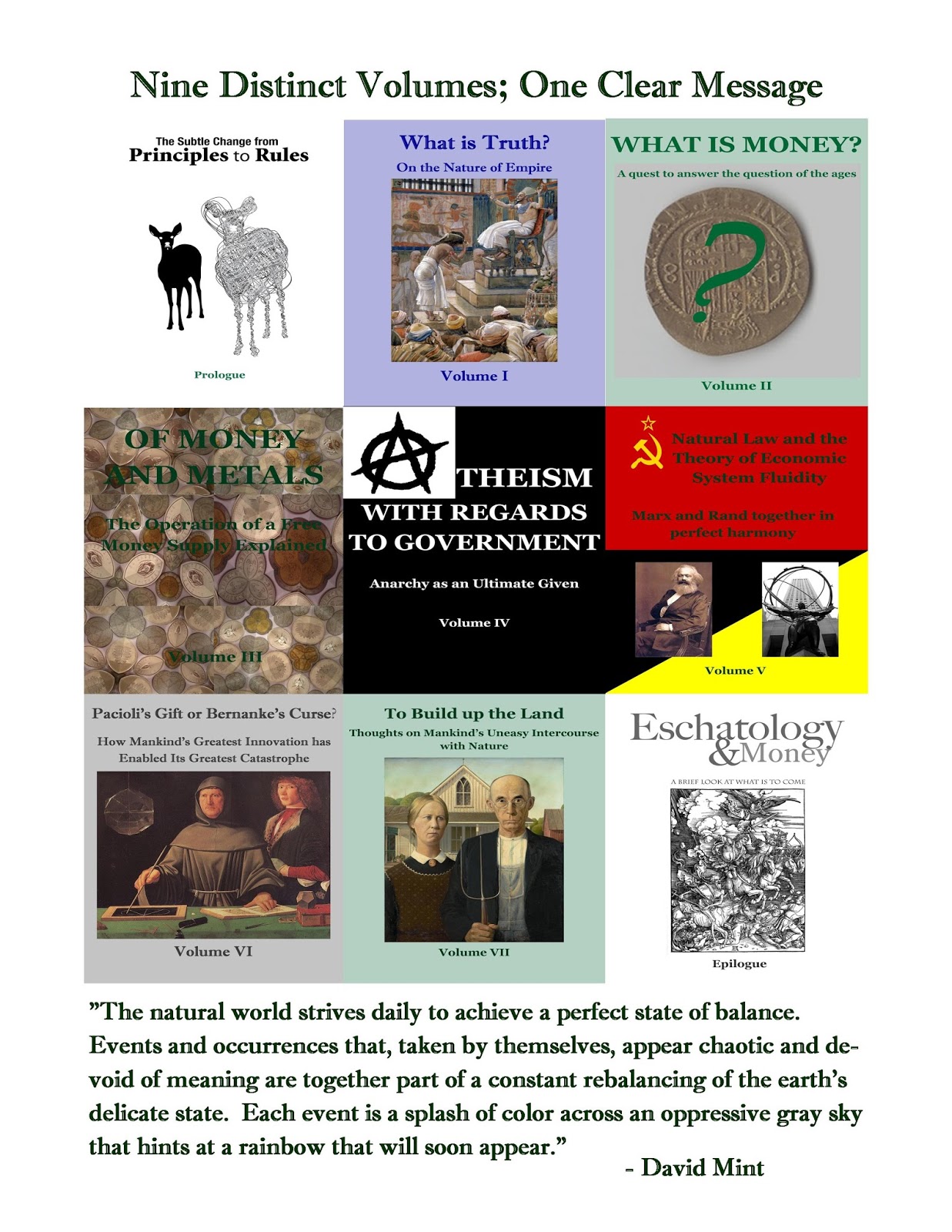
Why What We Use as Money Matters, Our Economic and Philosophical Treatise, is Now Available

Our long awaited Treatise on Economy and Philosophy, Why What We Use as Money Matters, is now available in various digital formats at Smashwords.com and on Kindle at Amazon.com.  With any luck, we will have a print version available before we leave for the Southern Hemisphere.

What kind of book is this?  It is largely up to the reader to decide.  For us, it is the fruit of two years of wrestling with some of life's deeper questions with regards to Economics, Politics, and Philosophy.  It has answered many of them and, in turn, has raised other issues, for in our exploration, as you will see, the current state of affairs is laid bare for all to examine, and our recommended courses of action may be unpalatable for many.
Nevertheless, there it is, altogether thick and challenging, yet refreshingly simple, the key to reversing the effects of climate change.


In a sense, it culminates the first phase of what we set out to do here at The Mint.  There will be more to come, but for the time being, we leave you to ponder the following brief excerpt:
"The natural world strives daily to achieve a perfect state of balance. Events and occurrences that, taken by themselves, appear chaotic and devoid of meaning are together part of a constant rebalancing of the earth's delicate state. Each event is a splash of color across an oppressive gray sky that hints at a rainbow that will soon appear. "

Friday, April 26, 2013

Natural Law and the Theory of Economic System Fluidity now available!

4/26/2013 Portland, Oregon - Pop in your mints…
Natural Law and the Theory of Economic System Fluidity
We are pleased to announce the release of our latest eBook offering, Natural Law and the Theory of Economic System Fluidity.
Natural Law and the Theory of Economic System Fluidity provides the theoretical basis for allowing the strengths of each economic system to peacefully work together to achieve this end and examines both the natural laws which govern economics as well as the moral basis for the existence of the nation state.
It is volume VI of the Why what we use as Money Matters series, and perhaps the most important, for it forms the philosophical core of our thesis.
We are pleased to offer it in PDF format for free here to our fellow taxpayers at The Mint.
Additionally, it can be had for a mere $0.99 over at Amazon's Kindle store and for free in a myriad of other eBook formats over and at Smashwords.com for the next month.  Be sure to use coupon code: WF75E at checkout to receive the discount.  The offer is good until May 25th, 2013.
Thanks again for reading and all the best!
Stay tuned and Trust Jesus.
Stay Fresh!
Key Indicators for April 26, 2013