Showing posts with label Monetary Theory. Show all posts

Sunday, February 22, 2015

Bitcoin Panel Illuminates the World of Crypto-currencies for the Oregon AFP

Bitcoin2/21/2015 Portland, Oregon - Pop in your mints...
For those who were unable to join us on Wednesday, the Bitcoin panel discussion at the Oregon AFP was a great success.  With us were six of the finest minds in Crypto-currencies in the Portland area.  These minds, together with some of the finest financial practitioners in the city, worked to bridge the gap between the Bitcoin universe and mainstream commerce. 
We were pleased to find that the two are really not that far apart.
While there were a number of keen insights shared at yesterday's meeting at the Multnomah Athletic Club, three stood out in our minds:
1) Transactions volume in Bitcoin has soared over the past two years and the USD/Bitcoin price action has settled down as a result.  Further, Venture Capital is pouring into the Bitcoin industry, proving that crypto-currencies, once on the exciting confluence of technology and money, are now entering the relatively boring yet infinitely more profitable economic mainstream.
2) Bitcoin innovators have largely solved the problem that has thus far kept most bankers at bay:  KYC, Know Your Customer.
3) Concerns about Bitcoin's wild fluctuations in value are addressed by services that instantly exchange Bitcoins accepted in trade into national currencies. This is especially important for those who transact day-to-day business in Bitcoin, as it is technically considered property for tax purposes and could otherwise create an accounting nightmare. It also allows for a clear delineation between Bitcoin speculation and Bitcoin circulation, two completely different activities before were often unwittingly commingled by virtue of one's use of Bitcoin in trade.
Bitcoin has come a long way since we published our 48 hour crash analysis of the emergent monetary revolution back in 2013, and our panelists did a superb job of presenting a balanced discussion of the present state of crypto-currencies.
A special thanks once again to all of our panelists, Lawrence I Lerner, Ian Pulicano, Anna Guyton, Mike Fors, George Fogg, and Rhys Faler, who was planning on spectating and found himself on the panel in the midst of an incredibly rich, informative, and relevant discussion of the merits and challenges of Bitcoin.
Ian had the difficult task of breaking the ice of ignorance and/or skepticism that is often associated with presenting the concept of Bitcoin to someone for the first time, which is never an easy task.  Beyond explaining the technical side in a concise manner, the slide near the end which highlighted the exponential growth in transactions and VC funding over the past 3 years got everyone's attention and set the stage nicely for the discussion that followed.  Anna did a great job of stepping up as moderator and added valuable insights throughout, Lawrence did an excellent job of bridging the knowledge gap between industry and Bitcoin through helpful analogies, Mike and Rhys provided the evidence that Bitcoin can and is being used in everyday transactions, and George added insight into the inherent challenges and opportunities of Bitcoin on the regulatory and securitization side of the house.
At the end of the hour, the audience was left with one inescapable conclusion: Crypto-currencies are here, are here to stay, and will be part of one's economic experience in the not too distant future.
For the benefit of those who were unable to join us yesterday, we offer the following bootleg recording of the event over at The Mint:  Bitcoin Panel Illuminates the World of Crypto-currencies for the Oregon AFP

Monday, April 28, 2014

A Discussion of the Merits of Short Term Interest Rate Management, Part I

4/28/2014 Portland, Oregon – Pop in your mints…

One of our working hypotheses here at The Mint is that short-term interest rate management, the primary tool employed by the Central Banks of the world to implement monetary policy, is necessarily harmful to the economy by providing incentives for achieving what otherwise would be suboptimal economic outcomes. By extension, we believe that these suboptimal outcomes are not simply a lost opportunity or a generator of wasted efforts and resources, but a primary contributor to the imbalances in the environment which today bears the label “climate change.”

Recently, we were invited to present our hypothesis at a Global Macro Roundtable for discussion. Today and over the next several days, we will present a slightly redacted transcript of the roundtable for the consideration of our fellow taxpayers. Names (with the obvious exception of our own) have been changed to protect both the innocent and guilty.

As you will see, the discussion (which we have color coded in order to help follow the cast through the maze of discussion) takes many twists and turns, and in a way reveals how far-reaching the influence of short-term interest rates has become, as well as the broad misunderstanding of the concept of money that persists to this day.

Enjoy!

A Discussion of the Merits of Short Term Interest Rate Management

The hypothesis:

Why Short-Term Interest Rate Management is Harmful to the Economy: The Unseen Funding Dynamic 

While the evidence is clear that centralized planning is a failure, pointing to the reasons why can prove elusive. Recently, a revelation regarding the problem with centralized management of short-term interest rates came upon us. The revelation is the following: Imagine you are a banker who needs to fund a loan. In order to fund this loan, you would presumably need to have the money available with which to fund it. This is simple logic, however, in the real world of banking, the decision of whether or not to fund a loan is completely disconnected from the availability of funds, which is primarily determined by the overnight funding markets which, in turn, are completely reliant upon short-term interest rates.

In a world that followed the rules of financial physics, the short-term interest rates would be completely dependent upon the availability of funds in the system. However, the centralized management of interest rates makes this critical data point, which would otherwise provide a snapshot of the amount of capital in an economic system which is held in liquid form and available for deployment, irrelevant, as the amount of capital available in today’s centrally managed system can be determined on whim.

As such, the ability of the banker to fund the loan is not dependent upon an availability of funds that represents the amount of capital available in the real world, rather, his ability to fund the loan is completely dependent upon the borrower’s ability to pay and the size of the loan in relation to the structure of the bank’s balance sheet.

The three criteria above are important, as any underwriter will tell you, but the invisible fourth criteria, the true availability of the funds for the loan, or funding dynamic, is completely ignored in the following fashion:

When the short-term interest is managed to be low, as is the case currently, any borrower who has the capacity to pay and has a lending need that fits well with a certain bank’s loan mix is extremely likely to get funded, regardless of whether or not the economics system as a whole has the capital available to fund his or her loan. When the short-term interest rate is managed to be high, as it was in the early 1980’s in the US, funding any loan, regardless of the ability to pay and fit within bank’s balance sheet, becomes impossible to fund.

In both cases, both borrower and banker are left completely in the dark as to whether or not there exists the necessary capital stock or productive capacity in the economy for the funds to be deployed in the manner that the borrower envisions, for the short-term interest rate signal has been genetically modified to send a common signal to all participants.

Unfortunately, it is a signal that blinds everyone to the facts of the situation. For many are the hopes, dreams, and ideas of mankind, but it is the funding dynamic which keeps these hopes, dreams, and ideas in harmony with the natural world upon which we all depend.

Right now, we are floating in the clouds, completely disconnected from reality. The landing caused by the next round of high rates, via a natural rebalancing of accounts or further genetic modification of the short-term rates, will be very hard indeed.

The funding dynamic is so delicate that mankind cannot hope to optimize it via genetic modification, for when left alone, it is optimized by definition. Again, by definition, every attempt to modify will bring about sub-optimal results.

As with all complex economic and political systems, dissent is information, and serves to manage the system’s outputs while at the same time increasing the resiliency of the system, making it less susceptible to shocks.

Centralized short-term interest rate management must be abandoned before it is too late, for it is leading the activities of mankind towards a dangerous showdown with the limitations of the natural world.

Discussion

Contributor A: This brings to mind the Pareto curve reaching a knee limit and catastrophe theory when there is a Quantum state change in the system being considered (the twig will snap, the water will boil as energy (money) is added, etc.). We are expanding the money supply and disregarding that eventually an infinite amount will be needed.

One other point is the Multiplier effect at the Bank who gets $ 1 Million from the fed and uses a low Reserve to make loans greatly exceeding that because the Loans are an asset on their books ; and, as repayments come in multipliers on those. Where does it stop? When the twig snaps and then raging inflation must kick in at an Exponential level with time. Then SNAP!

Contributor B: I have no disagreement with the conclusion, however, the facts leading there need to be adjusted/considered. For example, in the early 80′s, liquidity was not nearly the issue as it was raised in the statement. Not only did my clients acquire funding as required in that period, but I [stupidly] agreed to a mortgage in that period with an interest rate that still gives me nightmares. For the last few years interest rates have been suppressed, but at the same time my middle market clients have complained of there being insufficient liquidity to fund their business loans, meaning that new business ventures were not realised. This has relaxed in the past year or two slightly, but you need to remember one of the issues regarding the vast amount of dollars being held in banks.

When the FED began shipping huge quantities of dollars to friendly banks after the 2008 crash in order to stabilise some very shaky balance sheets, the FED promised to pay interest to the banks on those funds kept in storage with one absolutely unbreakable codicil: under no circumstances could the banks use those funds as part of their asset base in making loans. In other words, none, zero, zip, nada, NONE of those FED funds could be used for loans. Clearly, this move suppressed what would have been an immediately inflationary environment in the US, a highly destructive inflationary environment. But it also left these banks which were otherwise strapped for funds floundering for any money to loan out to their best small business customers. The banks may have stabililsed in the past few years of lean flow of funds, but it is not that much better in the commercial market for small and mid-sized customers.

The Mint: As Contributor A highlights, the entire modern monetary system is extremely fragile and, given its debt base, could quickly disintegrate were a crisis of confidence to emerge or a widespread failure of technology make it inaccessible.

Contributor B (to whom I will defer on funding experiences of the early 80′s) brings up an important point in the form of the “unbreakable codicil” of the FED with regards to funding intended to shore up the Federal Reserve system. While this move made the banks and system technically solvent, the Fed has ignored the fact that the US economy has outgrown the Federal Reserve system, as the economy is starved for money at a time when the Fed’s measurements indicate that quite the opposite is true.

In the 2008 panic, the Federal Reserve deviated significantly from its traditional funding mechanisms to save its system and has altered the normal monetary transmission protocol. I believe that this has created a feedback loop which will result in the Federal Reserve system receding and other mediums of exchange posturing to take its place.

Contributor B: I thoroughly agree that it will be reset, David. However, while you may see market forces and evolved consumer needs driving this reset, I tend to pay attention to the political aggression of states not at all amicable to the interests of the FED and believe the geopolitical transformation we will witness may be the lynchpin upon which the existence of the FED depends. In the long run it will not really matter to the FED whether it is driven by the economic needs of the consumer or the geopolitical ambitions of another nation, but it will matter to the ordinary participants, I suspect. The withering of FED control worn away by alternative exchange mechanisms will provide a much different life at ground level than the sudden repudiation of the USD as the world reserve currency as anticipated (and desired it seems) by the Chinese military (along with a few others who are tired of US economic hegemony). The former is a transformative change more gradual in nature while the latter can be far more sudden in keeping with the rapid shifts in the global market; the former providing the opportunity to adjust more peacefully while the latter is expected to lead to widespread disruptions in service, food, and support delivery at the ground level. Food riots, water riots, just plain riots, and toilet paper riots… sorry, basic staples of urban and 21st century life will be in short supply. I think I’ll find farmland in another country far away. ;-)

For ease of transition, I’d vote for alternative exchange mechanisms. Curiously, I saw an article a few weeks ago that noted extreme activity increases in southeast Asia on Bitcoin and the development of alternatives… either opportunity or another front in the attack on the USD. It can be both.
Now, to envision a world without central banks. That takes us back a while in history…

Then again, perhaps this graph {Editor’s Note: Regarding the Longevity of currency reserve status over the past 600 years} tells it all:
http://www.zerohedge.com/sites/default/files/images/user3303/imageroot/2012/01/20120103_JPM_reserve.png

… and speaking of market competitors, Googlecoin? it is being touted already.

Contributor C:
“Centralized short-term interest rate management must be abandoned before it is too late, for it is leading the activities of mankind towards a dangerous showdown with the limitations of the natural world.”
I like above statement. 

This game of interest rate putting up and down could create a crisis if somebody implemented at the wrong time. I consider interest rate as a weapon of mass of destruction if we manage it recklessly. Interest rate volatility creates problems for investors, homeowners and other savers. What about instruments linked to interest rates? What will happen if we don’t carefully manage or misuse those instruments? Why do we see higher interest rates in some periods and lower interest rates in some periods? Can’t we find solution to fix interest rates without creating volatility?”

The discussion, which is about to take many an unforeseen turn, continues tomorrow…things are about to get lively (at least lively as far as short-term interest rates discussions go) indeed!

Stay tuned and Trust Jesus.

Stay Fresh!

David Mint

Key Indicators for April 28, 2014

Copper Price per Lb: $3.07
Oil Price per Barrel: $100.93
Corn Price per Bushel: $5.07
10 Yr US Treasury Bond: 2.68%
Bitcoin price in US: $431.71
FED Target Rate: 0.10%
Gold Price Per Ounce: $1,303
MINT Perceived Target Rate*: 0.25%
Unemployment Rate: 6.7%
Inflation Rate (CPI): 0.2%
Dow Jones Industrial Average: 16,361
M1 Monetary Base: $2,721,500,000,000
M2 Monetary Base: $11,353,000,000,000

Tuesday, July 23, 2013

Why What We Use as Money Matters, Our Economic and Philosophical Treatise, is Now Available

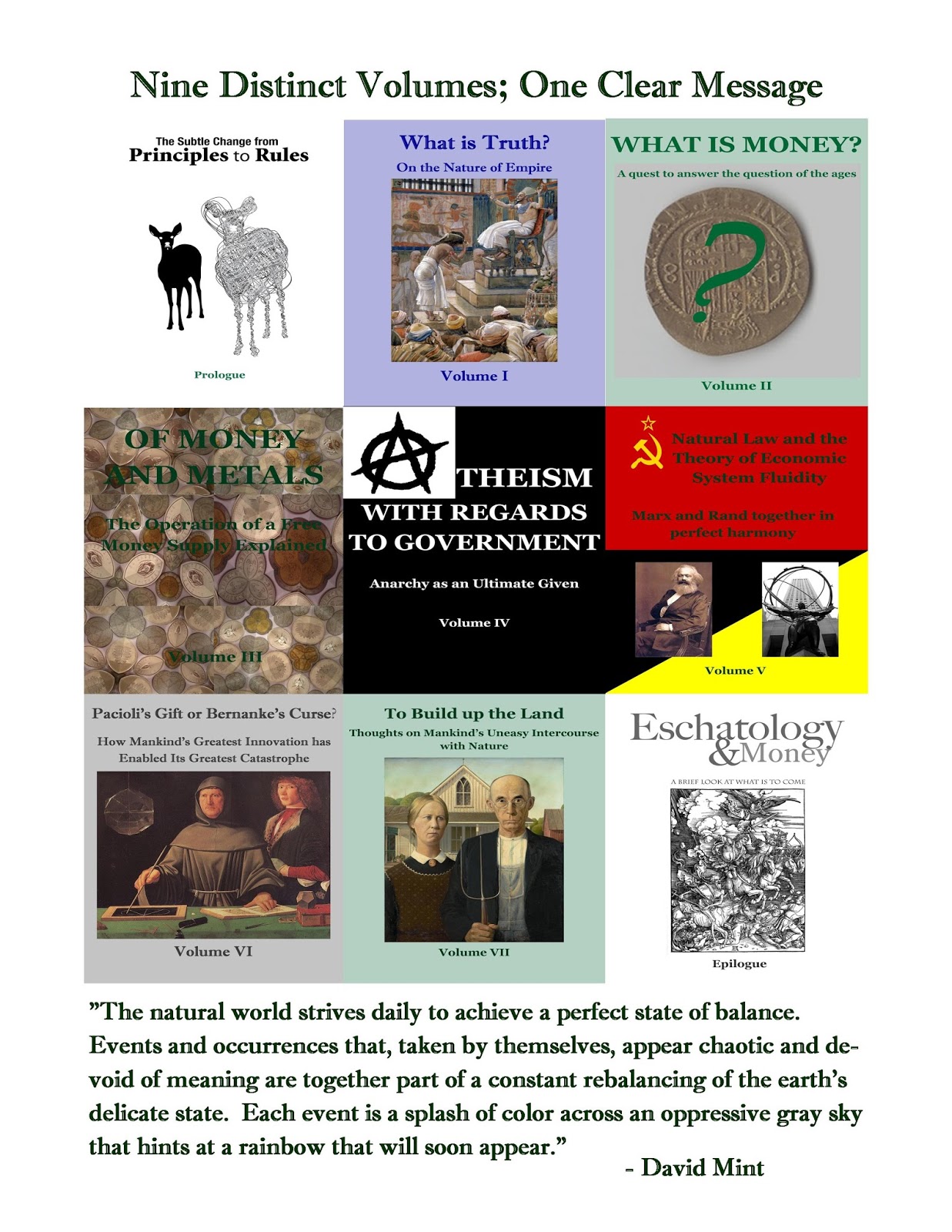
Our long awaited Treatise on Economy and Philosophy, Why What We Use as Money Matters, is now available in various digital formats at Smashwords.com and on Kindle at Amazon.com.  With any luck, we will have a print version available before we leave for the Southern Hemisphere.

What kind of book is this?  It is largely up to the reader to decide.  For us, it is the fruit of two years of wrestling with some of life's deeper questions with regards to Economics, Politics, and Philosophy.  It has answered many of them and, in turn, has raised other issues, for in our exploration, as you will see, the current state of affairs is laid bare for all to examine, and our recommended courses of action may be unpalatable for many.
Nevertheless, there it is, altogether thick and challenging, yet refreshingly simple, the key to reversing the effects of climate change.


In a sense, it culminates the first phase of what we set out to do here at The Mint.  There will be more to come, but for the time being, we leave you to ponder the following brief excerpt:
"The natural world strives daily to achieve a perfect state of balance. Events and occurrences that, taken by themselves, appear chaotic and devoid of meaning are together part of a constant rebalancing of the earth's delicate state. Each event is a splash of color across an oppressive gray sky that hints at a rainbow that will soon appear. "

Tuesday, February 26, 2013

To Build up the Land part II – God Made a Farmer


2/5/2013 Portland, Oregon – Pop in your mints…
Today we continue with our exploration of the concept of building up the land.  We are using, as our living example of someone who dedicated their life to building up a harsh land, a Swiss settler of the sandhills of western Nebraska, Old Jules.
Yesterday, before we deviated into our normal rant about the monetary premium being attached to debt instruments being the root cause of widespread resource misallocation and, by extension, what today is called “climate change,” we explored the idea that mankind was created to live in balance with the earth.
He was neither to overly molest it via excessive development nor ignore it via draconian conservation methods.  Rather, he was to build up the earth, and in turn allow himself to be built up by it.
There are preconditions for man to be able to live in balance with the land.  First and foremost, he must live in relative peace.  If one is to invest adequate time in building up the land, he or she cannot spend an inordinate amount of time preoccupied for and tending to their personal safety.  This is why war, far from being an economic boon, is ultimately fatal to man’s efforts to build up the land.
How, then, can peace be encouraged?  By allowing uninhibited trade between communist style communities, such as families or tribes.  As we explored yesterday, the link between free trade and peace is so strong that it can be said that if goods do not cross borders, soldiers will.
It all seems ideal, doesn’t it?  Living in peace, in perfect balance with nature and our fellow man.  It doesn’t sound like much to ask of everyone.  Yet in practice, building up the land is a difficult endeavor.  It is so difficult, that most people, when given the choice between working to build up the land and enjoying the fruits of the land, naturally choose the latter.  The debt based money supply has allowed an unprecedented number of humans to spend more of their time enjoying the fruits than building up the land, and every day that this situation persists brings the actions of mankind further out of balance with the need to “build up the land.”
What type of person chooses to build up the land?  In gentle climates, like the one we currently enjoy in Oregon, where a minimal effort in planting often leads to an above average yield, gentle persons can build up the land.  As the land is strong, the people don’t have to be.
This has been true of the indigenous groups who inhabited the territories and, at the risk of offending our fellow Portlanders, we dare say that it is true of the population today.  If one can stand the rain, life is relatively easy.  A gentle, forgiving land will produce a gentle and forgiving people.
The corollary to this, naturally, is that a hard and unforgiving land will initially yield a hard and unforgiving people.  Or, as Sunday’s Dodge Ram truck Super Bowl spot reminds us, on the eighth day, God made a Farmer:
Again for proof of this, we turn to Mari Sandoz’s account of her father, Old Jules.  Jules Sandoz, our settler of 100 years ago, lived in a harsh land.  He lived peacefully with the indigenous peoples there, who were being forced away by the Federal Army.  He lived less peacefully with the bankers and cattlemen, who attempted to claim the land he was trying to build up by force.
Sandoz give us a glimpse into her rough, determined, and surprisingly refined father:
“Jules Sandoz was not a nice man, but he was smart and tough and talented, and he was a survivor.”
“Old Jules was always ready to serve as a “locator,” to help a new arrival stake out a claim and “find his corners,” locate the precise boundaries of his land.  For this, he charged little or nothing, as he wanted so badly to “build up, build up” the community.”
“His (Old Jules’) house was briefly the local post office, until he feuded with the officials and they took it away.  His place was the unofficial storytelling center of the community.  His skinny daughter, Marie (later Mari {the author}), would hang back in the darkness to stay up and listen to the immigrants and Indians {Indigenous peoples} and, less frequently, the cowboys tell their tales.
Old Jules maintained a well-stocked medical kit and was the unofficial frontier doctor to one and all.  He befriended the local Indians, some of the last Lakotas to live free in lodges, tipis, near his home.  They called him “Straight Eye,” honoring his shooting skill.  He spent w

Monday, February 25, 2013

To Build up the Land – part I


2/4/2013 Portland, Oregon – Pop in your mints…
“Then once more he raised his head, his face alive, his eyes far-focused, burning.  He began to talk slowly, as though his lips were metal, stiffening.  “The whole damn sandhills is deserted.  The cattlemen are broke, the settlers about gone.  I got to start all over-ship in a lot of good farmers in the spring, build up–build–build–”
Old Jules’ dying words from the biography entitled “Old Jules” by Mari Sandoz
Today at The Mint, we continue our journey, and we are glad that you are along with us.  With the inflationary fruits of five, nay, 100 years of loose monetary policy beginning to destroy the very currencies which gave birth to them, the world will all too soon be left to pick up the pieces and boldly move forward when all hope is lost.
When there is no hope, one must fight to become hope.  This is our charge to you, fellow taxpayer.  Fortunately, this is far from the first time that mankind has found itself in this situation.  For inspiration, we look back roughly 100 years to a man who had a vision for a place that was then, as now, a place that is difficult to inhabit, the sandhills region of Northwestern Nebraska.  (The sandhills have appeared in the news as a possible route for the long delayed Keystone pipeline.)
That man is Old Jules.
Old Jules was a Swiss immigrant who settled in the sandhills and, as our title implies, devoted much of his interesting life to “building up the land.”  What does it mean to build up the land?  Your idea of building up the land probably means something quite different than my idea of building up the land, and we would both probably have visions quite different for building up the land than someone living 100 years ago, like Old Jules.
Yet all of our visions have merit, for the idea of building up the land, while it may manifest itself in any number of different ways, implies working with the land to help it produce.

The whole idea of man being able to help the land to increase its production and that production helping mankind, in turn, to increase their own production (or reproduction, to be precise), is a miracle.  For those who inhabit urban settings, it may seem a mystery from a far off place.
Yet it is the command received by Adam and Eve at the dawn of creation.
Man was never meant to sit back and simply eat the fruits passively produced by the land, rather, the creation and mankind were created to have an intercourse, if you will, with the fruit of one producing fruit in the other, and vice versa.  Mankind’s activities were meant to be intimately connected to the land.  Mankind is to build up the land, and, in return, the land will build up mankind.
While the Victorian Yeoman farmer ideal may immediately spring to mind when one thinks of building up the land, it should be clear to any thinking person that the division of labor is a far more productive and resilient system by which to build up the land and to reap the benefits of such building.
Even in the Yeoman model, the division of labor existed.  One fetched wood, another dug and plowed, another prepared food, still another shelter, and another fetched water, and so on.
The division of labor could flourish beyond close knit communal groups, such as families or tribes, only via a system of trade.  The concept of trade, which further enables the division of labor to operate, is important not only for the concept of building up the land, but also for the maintenance of peaceful relations amongst communal groups.
The link between mutual trade and maintaining peace between groups is inseparable.  In the words of Frederic Bastait:
“If goods do not cross borders, soldiers will.”
If all of these things, building up the land, the division of labor, and the necessity of trade, are to operate, the concept of money, or what is better described as the emergence of a good of the highest order which carries a monetary premium, must be tacitly agreed upon by all groups that engage in trade.
Today, circa 2013, there is something desperately wrong with where the monetary premium is placed today:  Central bank credits, or what most of us know as currency, or money.  The problem is that they are debt, and not part

Tuesday, February 19, 2013

The currency war to end all currency wars


1/29/2013 Portland, Oregon – Pop in your mints…
With Japan’s recent aggressive devaluation of the Yen, the financial news has again taken up the phrase “currency war” to describe any lack of coordination in the steady devaluation of fiat currencies across the globe.
In a recent piece over at the Financial Times, Niall Ferguson identifies the Bank of England as the current winner in the stealth currency war that is currently being waged.  While the Bank of England may be the winner, the losers are not other nations, as the term war would suggest, but rather the savings of those who are unfortunate to count bank accounts or debt instruments denominated in national currencies among their assets.
Who, then, are the winners in what we have dubbed the currency war to end all currency wars?  In a simplified sense, those who hold the Dow Jones Industrial stock index (not the individual stocks, which are, in the final analysis, a crap shoot) and those who own gold.

In an attempt to illustrate this point while at the same time saving 1,000 words, should the old adage hold true, we have created the following graph, which plots a normalization (which brings the sheer magnitude of the numbers down to a workable scale) of the M1 and M2 monetary measures against both the Dow Jones Industrial Average and gold prices, all averaged on a monthly basis since April of 1968.
Graph of Normalized DJIA and Gold assets classes vs. M1, M2, and Federal Funds Rate measures
Graph of normalized DJIA and Gold assets classes vs. M1, M2, and Federal Funds Rate measures
Those with a keen eye will notice that the only data point that has been on a downward trend since the US Dollar was officially released from the shackles of the gold standard on August 15, 1971 has been the Federal Funds Rate, which in theory should have an inverse relationship with all of the other data points.
We will leave you with three observations from our graphic exercise:
1.  The most volatile of the two asset data sets has been that of the Dow Jones Industrial Average.  However, despite its volatility, its overall trend tends to follow that of the M2, or expanded, money supply measure.
2.  The more stable of the two asset data sets has been gold, which has generally lagged growth in the M1, or base money supply to which it was tied to pre 1971.  Beginning in the year 2000, gold again began to follow the M1 trend.
3.  The light blue line, which tracks the Federal Funds Rate, has been on a downtrend.  The upticks in the Federal Funds Rate, in theory, should have lead to downward ticks in the M1 and M2   As you can see from the graph, this is not the case.
The conclusion of this brief analysis is the following:  Holding Stock Indices such as the Dow Jones should give some measure of protection against inflation over the long term, perhaps even superior to gold.  However, since 2000, gold has held steady as an inflation hedge and generally will have less liquidity risk than stocks.
Finally, and perhaps most importantly, is that upwards changes in the Federal Funds rate, even those as dramatic as were experienced during the Volcker years, have little or no effect on the near term trajectory of the M1 and M2 monetary measures and h

Tuesday, January 29, 2013

The Repo man goes Basel on funding markets

1/25/2013 Portland, Oregon – Pop in your mints…

We have been remiss in our regular correspondence to you, fellow taxpayer, and we pray you will forgive us.  We have completed and published the first two volumes in our series, called “Why what we use as Money Matters.”  It is our humble attempt to explain, well, why what we use as money matters.  The volumes are currently available on Amazon’s Kindle as wells as in various eBook formats on Smashwords and can be accessed at the following links:

What is Money? – Volume I – Free until February 7, 2013 at Smashwords
What is Money? By David Mint

Of Money and Metals -Volume 2 – Free until January 31, 2013 at Smashwords
Of Money and Metals by David MInt

Our objective in writing the series is to convince humanity of two truths:

1.  That if the activities of the earth are to be in balance with the available resources, money must be something natural, in other words, not debt or a sort of promise or idea.

2.  That Anarchy is an ultimate given, and that Capitalism is the best response to this given.

The governments of the world, as we have known them, are disintegrating, but this will be addressed in our upcoming volumes in the series.

We would be honored if you would give them a read and keep watch for the upcoming volumes, for these ideas are exceedingly important.

Back to finance

While the Fiscal cliff and subsequent fallout have taken a toll on the average working American to the count of 2% right where it counts, there is a something altogether wonderful and dreadful knocking at the door:

Inflation

The wave of inflation that has been on the horizon ever since Federal Reserve monetary policy gave us new acronyms such as ZIRP and QE, appears to be breaking and will soon wash ashore.  Now that it is breaking, the only thing that stands between it and the average working American is some flavor of collective default by the nation’s banks.  Thanks to the programs which are represented by the above mentioned acronyms, this is highly unlikely.

At this point, then, the only entities whose default could cause such a chain reaction are the Federal Reserve, US Treasury, or possibly the ECB.  However, here at The Mint we believe that the tidal waves of cash that have been unleashed may even make the default of one of these institutions manageable.

The Federal Reserve has succeeded in the sense that they have flooded the system with so much cash and have repeatedly stated in no uncertain terms that they will backstop the Treasury and MBS market until the US Dollar’s last dying breath.  While for a time, maturing debt obligations were mopping up the liquidity that the FED was pumping in, most consumers have now moved to extend maturities via refinancing or, on the conservative end, have closed out both cash and debt positions by paying off mortgages with savings which had been “ZIRPed” into dormance as an income producing asset.  This collective action has put the economy in a sort of warped reset where the fiat currency debt monster can run amok for the foreseeable future, with the attendant fatal real world consequences.


Oddly enough, as the FED begins to claim victory over the financial crises which its own policies have made possible, the double whammy of the Basel accords and Dodd-Frank regulatory regimens may eventually eliminate many of the financial institutions which today are household names.

The Repo man cometh

In what is perhaps an unintended consequence, the afore mentioned regulations have given what is known as a REPO contract its walking papers.  In our oversimplified understanding of the matter, for simplicity is a virtue here at The Mint, the REPO arrangement, which is a glorified demand deposit, has allowed banks to hold their client’s funds on their balance sheet as Tier I capital.

In 2017, these arrangements will be forced to be properly classified as demand deposits, and many of the wiser financial institutions, who already have a long way to go to reach the Basel Tier I requirements, are already steering their clients away from these arrangements.

How much capital will this pull out of the banking system?  Nobody knows.  But what is for sure is that unwinding these REPO positions will leave some institutions exposed and unprepared.  They will probably become aware of their exposure via the classic individual financial panic mechanism:
The margin call.

Stay tuned and Trust Jesus.

Stay Fresh!


Key Indicators for January 25 2013

Thursday, January 24, 2013

Of Money and Metals: The Operation of a Free Money Supply Explained

We’ve been at it again!  Be the first to download our newest e-book,  now available on Smashwords and Amazon’s Kindle:

Of Money and Metals: The Operation of a Free Money Supply Explained

Of Money and Metals: The Operation of a Free Money Supply Explained is Volume II in the “Why what we use as Money Matters” series. Of Money and Metals presents the fallacies of the current day practice of circulating debt in the place of money and explains the urgent need for and the operation of a free money supply. This volume also explores the phenomenon of Bitcoins and digital currencies.

It is available to our dear readers for free until January 31, 2013 at smashwords.com, just enter coupon code: MA65L

Thank you for your support!

Of Money and Metals by David MInt

Wednesday, January 23, 2013

What is Money? A quest to answer the question of the ages

Be the first to download our latest e-book, free until February 7, 2013:

What is Money?  A quest to answer the question of the ages

It is the first in our ‘Why what we use as Money Matters” series and is available now at smashwords.com, coupon code: PG74U

Available for Kindle at Amazon as well.

Thank you for your support!

Tuesday, May 15, 2012

Is Fiduciary money really money or cleverly disguised debt?

Back on April 30th, we shared this brief but informative interaction over at our main site, http://davidmint.com we reproduce it here for your reading pleasure.  Enjoy!
4/30/2012 Portland, Oregon -Pop in your mints…
As money managers are frantically rebalancing their portfolios in a vain effort to get out of the way of Apple’s 20 point decline and Spain’s central bank, whose reason for existing we cannot conjure at the moment, consults experts in toxic assets because it apparently cannot figure out how to perform the most basic of banking functions:  Writing down bad assets, we are waxing philosophical here at The Mint.
We will give the Spaniards the benefit of the doubt and assume that they know what should be done with the toxic assets, they just do not want to appear to have admitted that the vile sludge on the balance sheets of nearly all spanish banking institutions are worse than worthless without getting an expert opinion. 
The defunct Spanish Central Bank looking for unsophisticated Investors to clean their banking system's septic tank
These are smart people, no doubt, the money managers and central bankers involved in the debacle that is the western financial system, circa 2012.  It is for this reason that there should be great cause for concern when they appear completely uncapable of functioning when things do not go the way they planned.
For example, a properly functioning banking system would have no problem figuring out what to do with non-performing loans (the common name for the toxic assets that the central bankers so dread).  In fact, a properly functioning banking system, where real and not limitless fiduciary money was at stake, would have created an adequate quality control system to ensure that very few financial assets of the toxic variety live to see the light of day.  Those that did see the light of day would have beem properly discounted them to a point where all of their toxic side effects could be properly cleaned up should they spill over.
We must assume, then, that there is something dreadfully wrong with the banking system.  But what is it?
We began to ponder this question last week when we saw a post by an Ivy League trained economist.  The assertion that fiduciary money is money bothered us to the point where we were compelled to jump in to correct this unintentional error.
The Ivy league trained economist indulged us for a time and then, for reasons unknown, disabled commenting on the post.  We interpret this action as a concession of the point we are trying to make, either that or they just wanted to get rid of us, which, given our obvious charm, we can only assume is not the case.
What is important is that the post brought up a fallacy which we see it as part of our mission here at The Mint to debunk.
The fallacy, which is widely accepted as fact by money managers and Spanish central bankers alike, is that fiduciary money operates like money when in reality it is nothing more than a debt instrument in disguise. 
So which is it?  Is The Mint off its rocker or is there something to the error of this ”debt is money” point of view, as in, it is causing otherwise intelligent people to act in more and more absurd ways as the inevitable consequences of using debt as money rear their ugly head?
Simply stated, is fiduciary money really money, as the name implies, or is it technically debt?  It is a fine point that, to be honest, does not matter to most people on the planet, for what is commonly known as fiduciary money tends to operate as money in a way that is imperceptable to the members of society…until it doesn’t.
The true essence of fiduciary money is not money at all, but debt.  Granted, it may be a highly liquid and highly transferable form of debt, but that does not change the fact that when it is created at the bank, be it a local or central bank, it represents a debt of that bank, regardless of the ability of said bank to redeem the fiduciary money for specie money, which is what we hold out as worthy of the term money for purposes of analysis.
As you can see from our presentation of the interaction below, we attempted, in good faith, to convince the Ivy League trained economist that Federal Reserve notes, as their name implies, are debt and not money.
I have redacted the amicable interaction to highlight the applicable text of our interaction as it pertains to the case in point, is fiduciary money really money?
Please read on and decide for yourself.
{Editor’s note:  Out of respect for the Ivy League trained economist, we have removed all references to their identity, for it is not our intent to shame, discredit, or launch any form of personal attack on them, but rather, the fallacy surrounding mainstream economics’ treatment of fiduciary money in its analysis}.
The Mint (in response to the intial post):
I would like to point out that fiduciary money is not money, but rather debt which carries in its value a monetary premium which the market has chosen to assign it.
Ivy League trained economist:
“Perhaps this helps you David Mint. I wrote this back on March 8th.
{Link to content further asserting that fiduciary money is money, removed to protect economist’s identity}
The Mint:
Thanks again, however, I still cannot concede your assertions that Federal Reserve notes are money, rather, they are a debt instrument, which is often referred to as fiduciary money.
The proof of this lies in that Federal Reserve notes pay interest and trade at an implied discount rate, whereas money simply trades against other goods in a varying relationship determined by the relative scarcity of resources.
Both circulate as currency in a normal economy, but the rigidity of debt makes it unsuitable for obligatory legal tender.
It is a fine point that is categorically overlooked, but the more one forces debt into the role of money, the greater the disconnect between the activities of men and the resources available to support those activities.
I would love to hear a convincing argument that debt is money if you have one in your archives.
Thanks again and all the best!
Ivy League trained economist:
“Decidedly David Mint, Federal Reserve notes do not pay interest. There isn’t anyone on earth paying interest to anyone else who is holding a $5 bill in his wallet.
Here, David, disabuse yourself. See my many shares on what money is:
{Link to content further asserting that fiduciary money is money, removed to protect economist’s identity}
You ought to spend good time reading this one:

{Link to content further asserting that fiduciary money is money, removed to protect economist’s identity}
The Mint
Quickly, on the fallacy of the $5 bill which is held, the implied interest and discount rate on Federal Reserve notes traded amongst commercial and central banks still affect the value of the bill as it is held up until the moment it is given in exchange for trade.  The coupon rate is 0%, but the normal operations of debt instruments hold true for them.
From what admittedly little I have read of your work, I agree with 99% of what you present.  It is this fine point, that Federal Reserve notes behave as debt, even when they are part of the M1 money supply, that I believe is the error which is spread throughout mainstream economics.  Of this, I have yet to be disabused by what you have presented.
Debt includes all fiduciary money.  The point is important because using debt as money works until it doesn’t, meaning the issuer of the debt defaults or is widely perceived to have defaulted, and their debts become worthless in trade.
Ivy League trained economist:
“That’s all fine, except Federal Reserve bank notes are not debt.  Decidedly, Federal Reserve bank notes are money owning to bearer negotiability and ability to extinguish contracts.
Yet, Federal Reserve notes are not credits, and thus are not debt.  Federal Reserve notes are not even evidences of ownership of contracts.
At most anyone can say is that Federal Reserve notes represent a call on future products to be made by anonymous, as yet, identified others who likely shall take them in exchange.”
The Mint
As a matter of accounting necessity, the Federal Reserve must book a liability when it issues a Federal Reserve Note which makes their notes debt by definition.  If this were not the case, why would they list it as a liability on their balance sheet?
On the contrary, the most that anyone can say about Federal Reserve notes is that they are the highest and most liquid form of debt which is traded in the US economy.  However, this does not change the fact that the essence of the Federal Reserve note is debt.
The Ivy League trained economist unexpectedly exits stage left.
Who cares?  Why is this important?  It is important because if what we believe about fiduciary money is true, most of the Western world, including the mysteriously influential Paul Krugman (who is not, by the way, the anonymous Ivy League trained economist above), somehow believes that fiduciary money is money that can be produced at will, and that the world will be better off if we simply produced more of it.
If the Krugman’s of the world get their way, labor and accumulated capital will be so poorly allocated that it could take three generations for humanity to adequately organize itself to make good use of the earth’s inexhaustible reasources.  Do you have that kind of time?
Stay tuned and Trust Jesus.
Stay Fresh!
Key Indicators for April 30, 2012
FED Target Rate:  0.14%  ON AUTOPILOT, THE FED IS DEAD!