Showing posts with label Economics. Show all posts

Monday, January 12, 2015

Digital Silver

1/11/2015 Portland, Oregon - Pop in your mints…

A belated happy new year to our fellow taxpayers. While the pages of The Mint have been quiet, The Mint himself has been pressing forward on a number of initiatives. Perhaps the most notable being our renewed interest in Tax Planning and preparation, which is a natural complement to our virtual CFO and associated services. More to come on that.

Long-suffering readers of The Mint are well aware of our views on monetary theory. Throughout the ages, true money has generally taken the form of gold and/or silver. However, for roughly 44 years now, mankind has been on an extremely dangerous experiment in which debt has come to take the place of money in everyday transactions. While it may seem a completely normal manner of transacting business today, it is lost on most that money and debt are actually polar opposites. They are meant to cancel each other out in trade and, in doing so, maintain the quantity of one another and by extension all of world trade and economic activity, in balance.

However, when money becomes debt, then debt can only be cancelled by the issuance of more debt, which means that the primary impulse of all economic activity is not a well thought out response to the laws of supply and demand, but a response to whether or not the supply of debt instruments in the world is increasing or decreasing.

The period between 2008 and 2013 has been marked by a relative stagnation in what was until then a steady wave of increasing credit post 1971. This stagnation was almost fatal to the debt based monetary system that, by definition, counts on an infinite expansion in the quantity of debt for its very existence.

The current expansion, which began in 2014 and is set to accelerate through 2015 and beyond, is already causing cosmic shifts in the economy. Old, established companies and brands are being supplanted by a phenomenon that is best exemplified by social media platforms: Hyper focused content delivery and a wholesale fragmentation of what were, just five years ago, long-established norms around consumer behavior. Large brands are losing the edge as consumers can increasingly tailor the content that passes by their eyeballs on social media and, further, consume almost any type of media on demand.

This shift is once again propelling a large wave of growth, which means that soon, consumers will begin to demand increasing amounts of credit so that they can underwrite their various individual activities necessitated by this shift.

What place does Silver have in this brave new world? At $16.57 an ounce, physical silver is taking a short breather as the world's best investment. However, a new form of Silver is rising to take its place.
Silver Money
Digital Silver in the form of unsecured credit at your fingertips

Silver Money Service is a simple mobile app that filters hundreds of credit card offers to help you find unsecured credit that suits your needs. While at first this may seem an elementary concept, the utility of the Silver app, which is currently available for Android and iPhone, cannot be overstated.

As much as we are loath to admit it, most consumers will need to increase their credit footprint over the coming year in order to keep pace with inflation. What the Silver app does is simply save consumers tens if not hundreds of hours sifting through credit card offers in the mail and on the internet.  By asking a few simple questions, Silver guides the user to the current credit card offerings that are best suited to their needs.

How does it work?  As we mentioned above, the app asks the user a simple, multiple-choice question:
  1. Which type of card are you looking for?
    • Rewards
    • Cash back
    • Low Interest
    • Bad Credit
From there, it asks the user a second, again multiple choice question based on their response to the first in order to tailor its results to the user's unique credit needs.  The app then presents a list of the relevant credit card offers alongside buttons that allow the user to contact the credit card provider directly via telephone, email, or directly at their website.

Silver's refreshingly simple and intuitive approach to assisting consumers in expanding their credit footprint.  You can download this handy app that the Google Play store and the iPhone App Store today and get a head start on your peers.

While physical silver will always be a safe harbor, the Silver app may prove more useful over the coming years as a way to fund the next wave of credit expansion. Even if you are a gold or silver bug, you can use the Silver app to get a credit card to get ahead of the curve by ordering your next tube of rounds or silver bars from your favorite bullion dealer.

For in the blow off phase, it won't matter how much unsecured debt one has to pay back, but what real assets one has on hand to confront the gradual disintegration of the real economy.

Stay tuned and Trust Jesus.

Stay Fresh!

David Mint

Key Indicators for January 11, 2015

Copper Price per Lb: $2.79
Oil Price per Barrel (WTI):  $47.58
Corn Price per Bushel:  $4.00
10 Yr US Treasury Bond:  1.97%
Bitcoin price in US: $276.80
FED Target Rate:  0.12%
Gold Price Per Ounce:  $1,225
MINT Perceived Target Rate*:  0.25%
Unemployment Rate:  5.6%
Inflation Rate (CPI):  -0.3%
Dow Jones Industrial Average:  17,737
M1 Monetary Base:  $3,157,800,000,000
M2 Monetary Base:  $11,769,400,000,000

Wednesday, December 3, 2014

The Bank of Russia Dwarfed in Oil Price War

12/3/2014 Portland, Oregon - Pop in your mints…
In case you haven't been following our key indicators lately, the price of oil has taken a nosedive over the past three months, falling nearly 30% from late September.  If you drive an SUV or run an airline, this is great news.  If you are Russian or in some way invested in or employed by US based shale oil operations or work extracting oil from the Alberta Tar Sands, this is bad news.
First, let's take a look at the effects on Russia, which have dominated the headlines.  The Russian economy is heavily reliant on oil and has one of the largest petroleum industries in the world.  It has the world's eighth largest oil reserves and is the largest exporter of oil in the world in absolute numbers.  Since the chart below, which highlights the rise of Russia's productive capacity and post cold war era export capacity, was produced in by Plazak back in 2013, Russian production has continued its study rise through 2014, posting a post-Soviet record of 10.61 million barrels per day in September.

Russian Oil Production Chart By Plazak (Own work) [CC-BY-SA-3.0 (http://creativecommons.org/licenses/by-sa/3.0)], via Wikimedia Commons
Further, Russia produces approximately 73 barrels of oil per day per 1,000 inhabitants, compared with approximately 37 barrels of oil per day produced in the US per 1,000 people.
Oh yes, and it has been reported that the 2015-2017 budget forecast of the Russian Government was based on the assumption of oil being priced at $100 per barrel (they are now revising it to around $85, $20 some dollars ago in the real world).  Unlike the most of us in the US, that is a revenue assumption for them.
Financial markets are watching this and licking their chops, Russia is a short no matter how you slice it.  Their oil industry and economy live in a world that ceased to exist about the time the price of oil spiked and drove the world's largest consumers, the US, to search for alternatives.
The Bank of Russia: to the Rescue or Miscue?
The Russian Central Bank has spent at least $82 Billion in its foreign exchange reserves through October of 2014 in what has proven a feeble effort to prop up the Ruble.  It spent $700 million on Monday alone, and it is not working.  Were the heads of the Russian Central Bank thinking a bit more clearly, they may have been wise to carefully intervene in the oil markets before their currency got lashed.  Alas, the Central Bankers of the World are seldom blessed with the gift of clairvoyance.
But what about the US?  As the world's largest oil producer at nearly 12 million barrels a day, won't the United States economy fall victim to the latest drop in oil prices as well?  That is the premise of Michael Snyder, writing over at The Economic Collapse blog:
While Snyder does make some compelling points about the 1.7 million jobs that the fracking boom has produced, the US is nowhere near Russia in terms of oil price dependency for its economic health.
We have three concrete reasons that we place forward for your inspection, fellow taxpayer, as to why the impact on the US will be minimal or even positive:
1) While the US produces 12 million barrels per day, it consumes 18.8 million barrels.  As such, the higher price of oil still works as a quasi tax on the US as opposed to a concrete revenue source.
2) The US economy is the most dynamic on the planet.  As long as credit is available, it will create jobs.
3) The Fed is still in a mode of underpinning the economy and has maintained its unconditional guarantee of the post financial crisis stock and bond markets.  They would quickly contain the oil based junk bond issue that Snyder brings up.
The US economy is eternally susceptible to one thing and one thing only, a sustained decrease in consumer credit and government debt, neither of which is likely in the near term.  While the Fed has hinted at raising rates, the current crisis in Russia, if anything, gives them sway to keep their various stimuli in place or on the ready as the crisis is feeding dollar strength, so the Fed doesn't have to.
It will not always be so, as the Fed itself will one day implode on its own merits (or lack thereof).  For the moment, it is the Bank of Russia playing the jester in this play.
Stay tuned and Trust Jesus.
Stay Fresh!
David Mint
Key Indicators for December 3, 2014
Copper Price per Lb: $2.92
Oil Price per Barrel (WTI):  $67.10
Corn Price per Bushel:  $3.68
10 Yr US Treasury Bond:  2.29%

Bitcoin price in US:  $377.28
FED Target Rate:  0.13%

Gold Price Per Ounce:  $1,205

Monday, July 14, 2014

Negative rates and the no bid Repo: It’s not your father’s overnight funding market

7/14/2014 Portland, Oregon – Pop in your mints…

A great deal has occurred since our last correspondence, most of it bad news for what passes today as monetary policy.

Fellow taxpayers have no doubt noticed that our once faithful correspondence has been less than faithful over the past several months. While explanations amongst chums the likes of which we have become are unnecessary, we offer a brief glimpse as to how The Mint has been spending his precious time as of late.

For starters, we have been frantically reconstructing 2013 and making various systems upgrades on our most recent assignment. Now that the work has been done and passed audit, we are moving through regular compliance reports and are about to begin the second part, (our personal favorite) of our not quite patented one/two accounting and treasury systems overhaul: The treasury overhaul part of the program.

Here we digress into what we consider our unique philosophy on data processing with regards to accounting information systems. If you could care less about such matters, please scroll to the next bolded heading to return to our long running commentary on the failing debt based money supply.
A mere 11 years ago, we considered ourselves an accountant. We acted like an accountant, worked like an accountant, even smelled like an accountant (if indeed accountants can be said to have a smell about them).

Then we went to Spain, and had nothing short of an epiphany, which is as follows: Real business people could care less about proper accounting, they simply want the accounts collected and the bills paid, a steady stream of cash in the bank, and they want to get real-time financial metrics which will let them both know how their past decisions have fared and, more importantly, allow them to make better decisions about the future.

With this epiphany fresh in our mind, we realized that most accounting systems, while built by programmers to serve the business person, had been hijacked by accountants when they were set up, in most cases rendering the information the business person was to receive subject to seemingly infinite torture by the accountants before it could be presented, at which time the information was neither timely or useful to the business person.

With this realization, we developed our two-step approach to assisting business people in reclaiming their accounting data. The first step involves ensuring that the accounting system they are using is both adequate (it may come as a shock that many companies pay too much for systems that are no longer a good fit for them) and set up to capture and report the business’s financial data in a way that facilitates high level decision-making.

The second step involves addressing the issue of the timeliness of the data. We realized that in a great majority of transactions, the bank received the data before the accounting department did, and much valuable time and effort was wasted by waiting for the accounting department to input data into the accounting system, much of which was provided by the bank rather than internal sources, and then reconciling the system to the bank statement. The entire process was backwards, so we decided to perform data processing directly in the banks’ treasury management systems, where the transactions are initiated, approved, and executed, and have the bank data be easily uploaded into the accounting system, where it can be matched with vendor and client data and properly classified.

There you have it, it is much easier said than done, but once our program is complete, most companies we engage can get by with half of the accounting/fiscal personnel they had before, get their data in a timely and coherent manner, and usually end up saving money on their systems to boot.

In any event, between earning our daily bread in the above manner, watching the World Cup, and editing a taxonomic paper on Central American land crabs (which can be seen here:
http://biodiversitydatajournal.com/articles.php?id=1161), we have been following the disintegration of the debt based currency system from a comfortable distance. Our observations on the most recent ruptures follow:

The No bid Repo: It’s not your father’s overnight funding market

In the late 1980′s, the Federal Reserve had just begun what would be a series of automatic bailouts to the larger financial system. After Black Tuesday in 1987, it became clear to most sober observers that the Fed would do everything in its power, which at the time was limited to rigging short-term interest rates, to ensure that financial markets remained liquid at all costs.

Perhaps not coincidentally, in the late 1980′s, Oldsmobile ran a series of commercials with the tagline, “it’s not your father’s Oldsmobile,” which seemed to be a vain attempt to minimize the “Old” and emphasize the “mobile” part of its name. In case you don’t remember how exhilarating it was, videoarcheology.com brings it to life for us once again:


What did the strategy of the Fed and the strategy of Oldsmobile have in common? They both assumed that demand for their product, no matter how unappealing it was, would be infinite. Oldsmobile gave up the ghost in 2004, maybe people did want their father’s Oldsmobile after all.

The Fed is still hard at work, but their product, the debt-based currency used by most financial institutions in the United States and indeed throughout the world, is going the way of the Oldsmobile.

The Federal Reserve got by for nearly 95 years by monopolizing the ability to provide something for nothing, something that appealed to governments, companies, and consumers alike. They substituted debt for money, and in the process opened up a world of possibilities never before fathomed.
The plan went well, people began to circulate the debt in place of money, with those closest to the Fed paying the least and those furthest way paying more, and people toiled day in and day out to move further up the food chain.

Sure, using debt as money left the occasional sinkhole in the economy, on those rare occasions when more debts were being cancelled than issued, but the Fed simply lowered interest rates to provide adequate incentive for people to demand more debt, lowering the perceived price of getting something for nothing.

Now, circa 2014, the Fed has lowered interest rates to zero and has taken the extra step of creating even more debt of its own to circulate. While things should be going gangbusters at the Fed factory, we open the pages of the financial news to find that:

a) The Fed can no longer control the interest rate mechanism as it did before and;

b) The Repo market, which funds $1.6 trillion in short-term loans every business day, is going no bid on an increasingly regular basis thanks to the 2010 Dodd-Frank Act, which was supposed to fix these sort of problems.

{Editor’s Note: For a primer on the Repo Market, read this paper by the NY Fed: Key Mechanics of the U.S. Tri-Party Repo Market, we dare you}

The Federal Reserve’s debt based monetary system has reached its theoretical limit. While the ECB has toyed with the idea of negative interest rates, the US market, specifically US Treasuries which are sucked into the Repo Market nightly, is rendering negative rates on its own, and the Fed is powerless to stop it.

In layman’s terms, the game has flipped on the Fed, and now people and companies are essentially saying “lend me $100 today, and I’ll pay you back $97 in a year and we are square.” Crazy as it may sound, this is the reality on the fringe of the credit markets, and it is the price of continuing to deal in a debt-based currency that is passed its prime.

Let’s face it, Oldsmobile wasn’t cool in 1988. They had tinkered with it to such a degree that it would never again be your father’s Oldsmobile, and that was not a good thing. In the same way, between QE, Operation Twist, and near zero short-term rate targeting, Ben Bernanke has so severely mangled the Fed’s balance sheet with his tinkering that maintaining the integrity of the US dollar and US Treasuries as any sort of measure of reliable benchmark is all but impossible.

Now, the engine of the Fed’s debt based currency is beginning to lose speed via negative nominal rates, and Janet Yellen is looking into the toolbox, only to realize that Ben left most of the tools rigged in the engine of the Fed’s Balance sheet, and that moving any one of them will cause a catastrophic failure of the currency. Not to mention that long-awaited, highly inflationary wage – price spiral is about to kick in.

Academic economists will one day struggle to explain what is happening now, while inflation rises, interest rates continue to dip further, going negative at the top of the financial food chain, and the Fed is left with nothing but rhetoric with which to attempt to execute monetary policy. This is likely to get ugly and, if possible, defy the laws of finance and perhaps even mathematics before the game is up.
Stay tuned and Trust Jesus.

Stay Fresh!

David Mint

Key Indicators for July 14, 2014

Copper Price per Lb: $3.25
Oil Price per Barrel: $100.51
Corn Price per Bushel: $3.78
10 Yr US Treasury Bond: 2.52%
Bitcoin price in US: $618.00
FED Target Rate: 0.09%
Gold Price Per Ounce: $1,339
MINT Perceived Target Rate*: 0.25%
Unemployment Rate: 6.1%
Inflation Rate (CPI): 0.4%
Dow Jones Industrial Average: 16,944
M1 Monetary Base: $2,961,000,000,000
M2 Monetary Base: $11,284,500,000,000

Sunday, June 22, 2014

The ECB negative rate announcement is a cannibalistic non-event

6/22/2014 Portland, Oregon – Pop in your mints…

On June 5th, the European Central Bank made modern Central Banking history by providing the world with its first announcement of what they call a negative interest rate. For those who may be scratching their heads at the concept of a negative interest rate, we offer the following layman’s definition:

It is a commission that is charged every month for holding too many Euros in the wrong place.
In the mind of the clever central banker, a negative interest rate provides a simple disincentive to hoard Euros. In his or her mind, the way to invigorate the European economy is to force Euros into circulation by turning them into a sort of hot potato, though at -0.10% the analogy is more akin to a potato emanating scarcely enough heat to melt a pat of butter.

Following the infallible logic of the central banker, the banks will take the money and lend it, as putting 100% of deposits at risk via a loan in a terribly disjointed economic zone is clearly a better alternative that loosing a guaranteed 0.10% annually by parking it overnight at the ECB.

This would be a brilliant solution were the simple hoarding of Euros the only thing ailing the Euro system. Unfortunately for the ECB and indeed, Euro holders in general, the problem with the Euro is that it is dying a strange death at the hands of deflation and strangulating the European economy in the process. Following this set of facts, it would hold that the safer bet for those who find themselves holding excess Euros would be to pay down higher rate liabilities in lieu of holding Euros overnight at the cannibalistic ECB, whose actions, while for the moment are foreseen to be a non-event, will ultimately lead to an implosion of the 15 year-old Euro currency.

What is lost on the European central bank is that they are managing a debt-based currency that looks like money but smells something much different. While charging a commission on bank deposits in hopes of getting currency flowing again may seem a good idea, the dynamics of the debt-based currency make this strategy akin to economic suicide. Fabian for Liberty appears to take a slightly different slant on the subject and arrives at the same conclusion:


Debt is the lifeblood of modern currency, and a large part of what gives debt based currency its allure is the illusion of getting something for nothing in the form of usury. On June 5th, the ECB pierced the veil on interest rates and the illusion of getting something for nothing along with it. This has never been attempted by a modern monetary authority, and once again the ECB has shown that if there are errors to be made in the management of debt based currency, they are willing to make it.

Stay tuned and Trust Jesus.

Stay Fresh!

David Mint

Key Indicators for June 22, 2014

Copper Price per Lb: $3.10
Oil Price per Barrel: $106.83
Corn Price per Bushel: $4.53
10 Yr US Treasury Bond: 2.62%
Bitcoin price in US: $599.07
FED Target Rate: 0.10%
Gold Price Per Ounce: $1,315
MINT Perceived Target Rate*: 0.25%
Unemployment Rate: 6.3%
Inflation Rate (CPI): 0.4%
Dow Jones Industrial Average: 16,947
M1 Monetary Base: $2,728,900,000,000
M2 Monetary Base: $11,306,300,000,000

Monday, April 28, 2014

A Discussion of the Merits of Short Term Interest Rate Management, Part I

4/28/2014 Portland, Oregon – Pop in your mints…

One of our working hypotheses here at The Mint is that short-term interest rate management, the primary tool employed by the Central Banks of the world to implement monetary policy, is necessarily harmful to the economy by providing incentives for achieving what otherwise would be suboptimal economic outcomes. By extension, we believe that these suboptimal outcomes are not simply a lost opportunity or a generator of wasted efforts and resources, but a primary contributor to the imbalances in the environment which today bears the label “climate change.”

Recently, we were invited to present our hypothesis at a Global Macro Roundtable for discussion. Today and over the next several days, we will present a slightly redacted transcript of the roundtable for the consideration of our fellow taxpayers. Names (with the obvious exception of our own) have been changed to protect both the innocent and guilty.

As you will see, the discussion (which we have color coded in order to help follow the cast through the maze of discussion) takes many twists and turns, and in a way reveals how far-reaching the influence of short-term interest rates has become, as well as the broad misunderstanding of the concept of money that persists to this day.

Enjoy!

A Discussion of the Merits of Short Term Interest Rate Management

The hypothesis:

Why Short-Term Interest Rate Management is Harmful to the Economy: The Unseen Funding Dynamic 

While the evidence is clear that centralized planning is a failure, pointing to the reasons why can prove elusive. Recently, a revelation regarding the problem with centralized management of short-term interest rates came upon us. The revelation is the following: Imagine you are a banker who needs to fund a loan. In order to fund this loan, you would presumably need to have the money available with which to fund it. This is simple logic, however, in the real world of banking, the decision of whether or not to fund a loan is completely disconnected from the availability of funds, which is primarily determined by the overnight funding markets which, in turn, are completely reliant upon short-term interest rates.

In a world that followed the rules of financial physics, the short-term interest rates would be completely dependent upon the availability of funds in the system. However, the centralized management of interest rates makes this critical data point, which would otherwise provide a snapshot of the amount of capital in an economic system which is held in liquid form and available for deployment, irrelevant, as the amount of capital available in today’s centrally managed system can be determined on whim.

As such, the ability of the banker to fund the loan is not dependent upon an availability of funds that represents the amount of capital available in the real world, rather, his ability to fund the loan is completely dependent upon the borrower’s ability to pay and the size of the loan in relation to the structure of the bank’s balance sheet.

The three criteria above are important, as any underwriter will tell you, but the invisible fourth criteria, the true availability of the funds for the loan, or funding dynamic, is completely ignored in the following fashion:

When the short-term interest is managed to be low, as is the case currently, any borrower who has the capacity to pay and has a lending need that fits well with a certain bank’s loan mix is extremely likely to get funded, regardless of whether or not the economics system as a whole has the capital available to fund his or her loan. When the short-term interest rate is managed to be high, as it was in the early 1980’s in the US, funding any loan, regardless of the ability to pay and fit within bank’s balance sheet, becomes impossible to fund.

In both cases, both borrower and banker are left completely in the dark as to whether or not there exists the necessary capital stock or productive capacity in the economy for the funds to be deployed in the manner that the borrower envisions, for the short-term interest rate signal has been genetically modified to send a common signal to all participants.

Unfortunately, it is a signal that blinds everyone to the facts of the situation. For many are the hopes, dreams, and ideas of mankind, but it is the funding dynamic which keeps these hopes, dreams, and ideas in harmony with the natural world upon which we all depend.

Right now, we are floating in the clouds, completely disconnected from reality. The landing caused by the next round of high rates, via a natural rebalancing of accounts or further genetic modification of the short-term rates, will be very hard indeed.

The funding dynamic is so delicate that mankind cannot hope to optimize it via genetic modification, for when left alone, it is optimized by definition. Again, by definition, every attempt to modify will bring about sub-optimal results.

As with all complex economic and political systems, dissent is information, and serves to manage the system’s outputs while at the same time increasing the resiliency of the system, making it less susceptible to shocks.

Centralized short-term interest rate management must be abandoned before it is too late, for it is leading the activities of mankind towards a dangerous showdown with the limitations of the natural world.

Discussion

“Contributor A: This brings to mind the Pareto curve reaching a knee limit and catastrophe theory when there is a Quantum state change in the system being considered (the twig will snap, the water will boil as energy (money) is added, etc.). We are expanding the money supply and disregarding that eventually an infinite amount will be needed.

One other point is the Multiplier effect at the Bank who gets $ 1 Million from the fed and uses a low Reserve to make loans greatly exceeding that because the Loans are an asset on their books ; and, as repayments come in multipliers on those. Where does it stop? When the twig snaps and then raging inflation must kick in at an Exponential level with time. Then SNAP!

Contributor B: I have no disagreement with the conclusion, however, the facts leading there need to be adjusted/considered. For example, in the early 80′s, liquidity was not nearly the issue as it was raised in the statement. Not only did my clients acquire funding as required in that period, but I [stupidly] agreed to a mortgage in that period with an interest rate that still gives me nightmares. For the last few years interest rates have been suppressed, but at the same time my middle market clients have complained of there being insufficient liquidity to fund their business loans, meaning that new business ventures were not realised. This has relaxed in the past year or two slightly, but you need to remember one of the issues regarding the vast amount of dollars being held in banks.

When the FED began shipping huge quantities of dollars to friendly banks after the 2008 crash in order to stabilise some very shaky balance sheets, the FED promised to pay interest to the banks on those funds kept in storage with one absolutely unbreakable codicil: under no circumstances could the banks use those funds as part of their asset base in making loans. In other words, none, zero, zip, nada, NONE of those FED funds could be used for loans. Clearly, this move suppressed what would have been an immediately inflationary environment in the US, a highly destructive inflationary environment. But it also left these banks which were otherwise strapped for funds floundering for any money to loan out to their best small business customers. The banks may have stabililsed in the past few years of lean flow of funds, but it is not that much better in the commercial market for small and mid-sized customers.

The Mint: As Contributor A highlights, the entire modern monetary system is extremely fragile and, given its debt base, could quickly disintegrate were a crisis of confidence to emerge or a widespread failure of technology make it inaccessible.

Contributor B (to whom I will defer on funding experiences of the early 80′s) brings up an important point in the form of the “unbreakable codicil” of the FED with regards to funding intended to shore up the Federal Reserve system. While this move made the banks and system technically solvent, the Fed has ignored the fact that the US economy has outgrown the Federal Reserve system, as the economy is starved for money at a time when the Fed’s measurements indicate that quite the opposite is true.

In the 2008 panic, the Federal Reserve deviated significantly from its traditional funding mechanisms to save its system and has altered the normal monetary transmission protocol. I believe that this has created a feedback loop which will result in the Federal Reserve system receding and other mediums of exchange posturing to take its place.

Contributor B: I thoroughly agree that it will be reset, David. However, while you may see market forces and evolved consumer needs driving this reset, I tend to pay attention to the political aggression of states not at all amicable to the interests of the FED and believe the geopolitical transformation we will witness may be the lynchpin upon which the existence of the FED depends. In the long run it will not really matter to the FED whether it is driven by the economic needs of the consumer or the geopolitical ambitions of another nation, but it will matter to the ordinary participants, I suspect. The withering of FED control worn away by alternative exchange mechanisms will provide a much different life at ground level than the sudden repudiation of the USD as the world reserve currency as anticipated (and desired it seems) by the Chinese military (along with a few others who are tired of US economic hegemony). The former is a transformative change more gradual in nature while the latter can be far more sudden in keeping with the rapid shifts in the global market; the former providing the opportunity to adjust more peacefully while the latter is expected to lead to widespread disruptions in service, food, and support delivery at the ground level. Food riots, water riots, just plain riots, and toilet paper riots… sorry, basic staples of urban and 21st century life will be in short supply. I think I’ll find farmland in another country far away. ;-)

For ease of transition, I’d vote for alternative exchange mechanisms. Curiously, I saw an article a few weeks ago that noted extreme activity increases in southeast Asia on Bitcoin and the development of alternatives… either opportunity or another front in the attack on the USD. It can be both.
Now, to envision a world without central banks. That takes us back a while in history…

Then again, perhaps this graph {Editor’s Note: Regarding the Longevity of currency reserve status over the past 600 years} tells it all:
http://www.zerohedge.com/sites/default/files/images/user3303/imageroot/2012/01/20120103_JPM_reserve.png

… and speaking of market competitors, Googlecoin? it is being touted already.

Contributor C:
“Centralized short-term interest rate management must be abandoned before it is too late, for it is leading the activities of mankind towards a dangerous showdown with the limitations of the natural world.”
I like above statement. 

This game of interest rate putting up and down could create a crisis if somebody implemented at the wrong time. I consider interest rate as a weapon of mass of destruction if we manage it recklessly. Interest rate volatility creates problems for investors, homeowners and other savers. What about instruments linked to interest rates? What will happen if we don’t carefully manage or misuse those instruments? Why do we see higher interest rates in some periods and lower interest rates in some periods? Can’t we find solution to fix interest rates without creating volatility?”

The discussion, which is about to take many an unforeseen turn, continues tomorrow…things are about to get lively (at least lively as far as short-term interest rates discussions go) indeed!

Stay tuned and Trust Jesus.

Stay Fresh!

David Mint

Key Indicators for April 28, 2014

Copper Price per Lb: $3.07
Oil Price per Barrel: $100.93
Corn Price per Bushel: $5.07
10 Yr US Treasury Bond: 2.68%
Bitcoin price in US: $431.71
FED Target Rate: 0.10%
Gold Price Per Ounce: $1,303
MINT Perceived Target Rate*: 0.25%
Unemployment Rate: 6.7%
Inflation Rate (CPI): 0.2%
Dow Jones Industrial Average: 16,361
M1 Monetary Base: $2,721,500,000,000
M2 Monetary Base: $11,353,000,000,000

Sunday, November 3, 2013

Why What We Use as Money Matters

11/3/2013 Portland, Oregon – Pop in your mints…
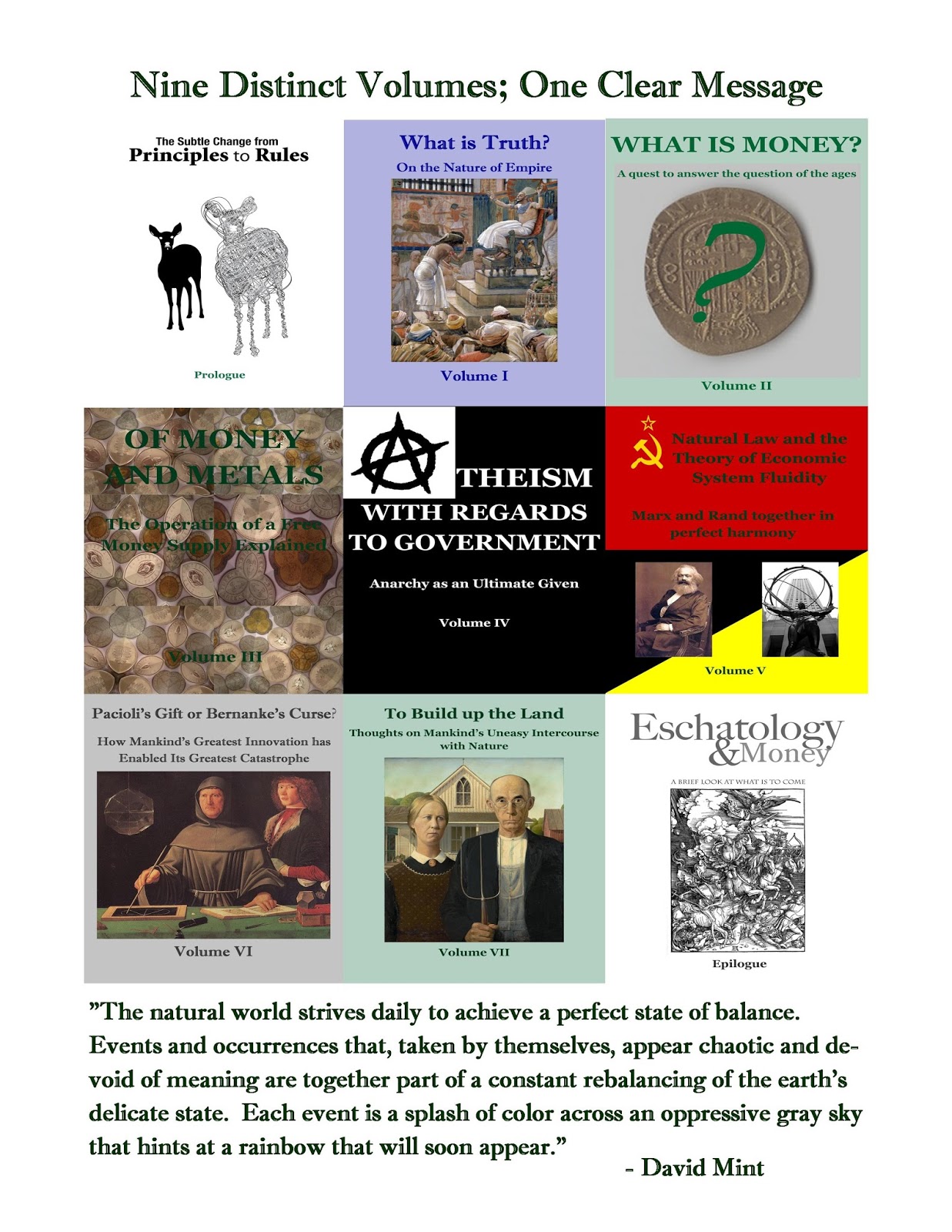
Could it be that it is not how, but what we use as money that matters when contemplating the root causes of Climate Change and other global problems? This is the question that is at the root of our Economic and Philosophical Treatise which bears the cryptic name:
Why What We Use as Money Matters
Why What We Use as Money Matters now in print!
Our Monetary Magnum Opus is now available in print at the following embedded links onAmazon.com and Createspace.com.
While there seems to be an endless debate as to what humankind should do in order to reduce our impact on the environment, ironically most of this and indeed countless other political debates result in more action being taken, either to cease and desist an activity or mobilize to clean up and reduce future environmental impacts of certain actions.
However, every action brings about some sort of reaction, often in the form of an “unintended consequence” which serves to negate any good that the carrying out of the well intended initial mandate had managed to accomplish.
Despite Al Gore’s call to action, realistic and manageable solutions to Climate Change remain elusive. As such, where Gore and other Climate crusaders have failed, we have been compelled to step in. You see, there is really a quite simple, certain, and palatable solution to Climate Change that could be implemented today.
The solution lies not in well-known solutions such as recycling, Cap and Trade schemes, development restrictions, technological advances, or taxes and other social engineering methods. In fact, it has absolutely nothing to do with what people do or what they or their governments spend their money on.
It lies in What we use as money circa 2013.
What the world uses as money is not really money, but a highly liquid debt instrument. While the difference is imperceptible to most, the accumulation of mistaken incentives and resulting actions on behalf of humankind which are inherent in the insane debt as currency model are beginning to manifest themselves in nature, and nature itself is beginning to bring itself into balance unilaterally.
Where humankind and the land once lived in a peaceful, mutually beneficial balance with one another, the relationship has become antagonistic and will remain so until the defects in the money supply are remedied.
How, then, can these defects be remedied? Ah, fellow taxpayer, it is for this reason that the above mentioned book contains 400 pages, for while the answer is simple, it will require that humankind let go of some deeply ingrained ideas which a vast majority of us do not even know we hold fast to.
Start letting go by ordering your copy today!
Print editions are currently available at Amazon.com and Createspace.com and Electronic editions are available on Amazon’s Kindle, Barnes & Noble, Google’s Play Store, and a variety of formats via Smashwords.
Thank you for joining us in this quest.
Stay tuned and Trust Jesus!
Stay Fresh!

Tuesday, July 23, 2013

Why What We Use as Money Matters, Our Economic and Philosophical Treatise, is Now Available

Our long awaited Treatise on Economy and Philosophy, Why What We Use as Money Matters, is now available in various digital formats at Smashwords.com and on Kindle at Amazon.com.  With any luck, we will have a print version available before we leave for the Southern Hemisphere.

What kind of book is this?  It is largely up to the reader to decide.  For us, it is the fruit of two years of wrestling with some of life's deeper questions with regards to Economics, Politics, and Philosophy.  It has answered many of them and, in turn, has raised other issues, for in our exploration, as you will see, the current state of affairs is laid bare for all to examine, and our recommended courses of action may be unpalatable for many.
Nevertheless, there it is, altogether thick and challenging, yet refreshingly simple, the key to reversing the effects of climate change.


In a sense, it culminates the first phase of what we set out to do here at The Mint.  There will be more to come, but for the time being, we leave you to ponder the following brief excerpt:
"The natural world strives daily to achieve a perfect state of balance. Events and occurrences that, taken by themselves, appear chaotic and devoid of meaning are together part of a constant rebalancing of the earth's delicate state. Each event is a splash of color across an oppressive gray sky that hints at a rainbow that will soon appear. "